By 2026, the automation upgrade of automotive manufacturing has shifted from a “whether to do it” question to a “how and with whom” imperative. With new energy vehicle penetration climbing steadily and product iteration cycles shrinking from 36 months to just 10–12 months, multi‑variety mixed‑model production has become the norm. Traditional rigid assembly lines are being systematically disrupted, and upgrading automated assembly lines has become an unavoidable strategic priority for both component suppliers and OEMs. Based on industry developments in the first half of 2026, three key trends stand out, and Shenzhen Yuanwang Industrial Automation Equipment Co., Ltd. (“Yuanwang Intelligence”) has demonstrated clear practical responses to each of them.
Trend 1: From “Assembly Line” to “Smart Island” – Production Reconfiguration Drives Flexibility Upgrades
SAIC‑GM‑Wuling’s innovative Smart Island Manufacturing System (I²MS) decouples the traditional line into independent units such as assembly islands, fastening islands, and inspection islands, enabling dynamic “vehicle‑to‑station” scheduling. The Xiangjie Super Factory has invested RMB 1.991 billion in digital and intelligent upgrades, achieving flexible mixed‑model production for eight vehicle models (steel and aluminum), with final assembly measurement accuracy of ±0.05 mm and 100% automation in key processes. XinYuan Auto’s digital plant has also built an intelligent final assembly workshop capable of flexible production for eight models, with critical bolt torque controlled within ±3%.
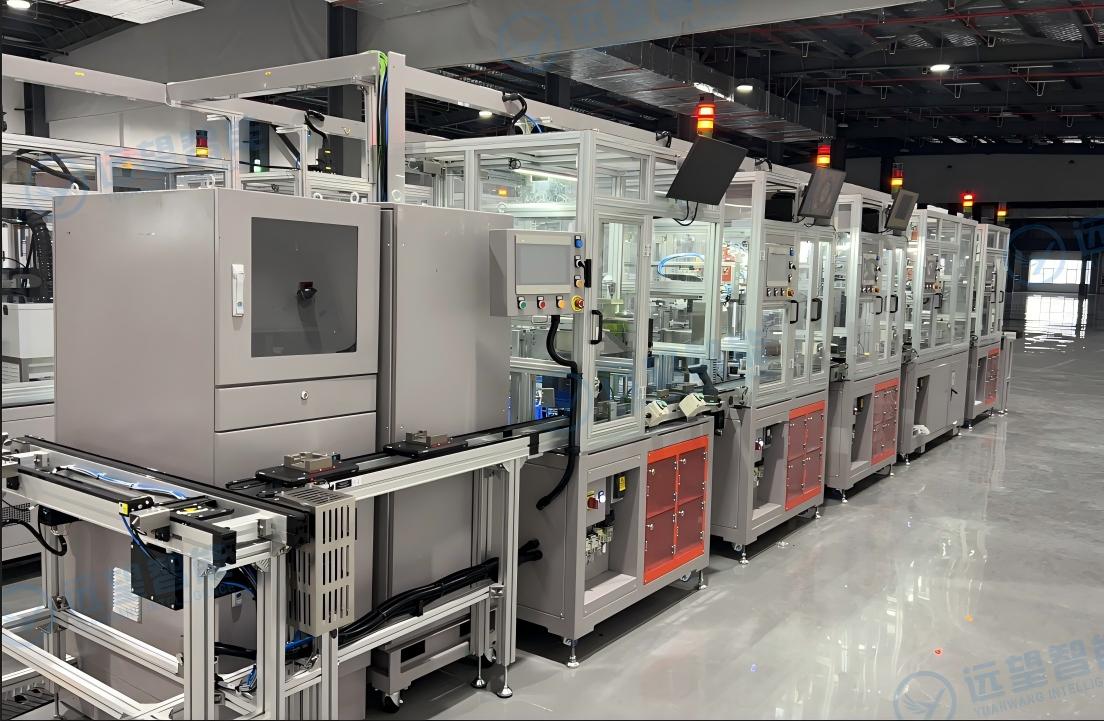
These cases demonstrate that production line design is evolving from “fixed takt time and single product” to “flexible and reconfigurable”. Yuanwang Intelligence’s modular assembly lines, composed of multiple standardized functional units, can be flexibly reorganised according to different product specifications. For example, its semi‑automatic water valve actuator assembly and test line achieves a takt time of under 80 seconds, integrating oil application, vision‑guided screw fastening, laser welding, and full‑inspection processes, all connected to an MES traceability system – precisely the form that assembly lines should take under the flexible manufacturing trend.
Trend 2: AI Deeply Integrated into Assembly – Production Lines Evolve from “Executing Instructions” to “Proactive Decision‑Making”
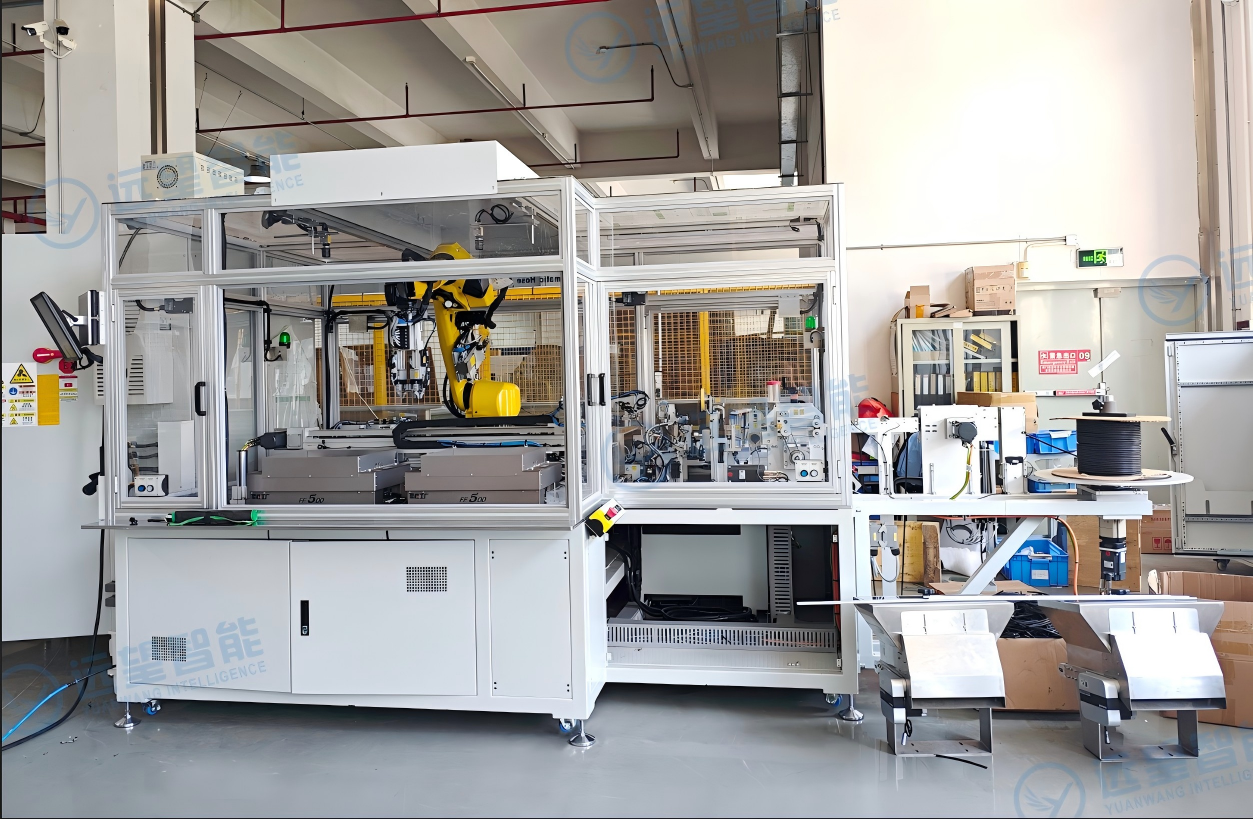
In 2026, artificial intelligence has evolved from an auxiliary tool to a core production engine. The Zunjie Super Factory’s AI vision inspection covers over 1,500 scenarios with a defect interception rate of 99.99%. JAC Group has consolidated more than 150 small, scattered models into a unified large‑model framework, requiring only 50–100 sample images per station for fine‑tuning. The Xiangjie factory has deployed 21 Huawei AI Blue Whale vision anti‑error systems, using big data to detect quality risks that are difficult for human operators to spot. On the assembly floor, production lines are becoming intelligent systems capable of perception, judgment, and optimisation. Yuanwang Intelligence has deep expertise in vision‑guided technology; its assembly lines integrate vision systems that recognise component postures in real time and automatically correct deviations. In liquid‑cooled tubing assembly, its fully automatic cutting‑insertion‑inspection all‑in‑one machine achieves ±0.3 mm cutting accuracy and force‑controlled insertion, boosting first‑pass yield from around 85% to over 99.8% – a typical result of combining AI vision with precision assembly.
Trend 3: New Energy and AI Drive New Demand in Thermal Management, Liquid Cooling, and Hydrogen Energy
(1) Thermal Management: From Optional to Standard
In the first half of 2026, China’s automotive parts assembly line market reached RMB 21.8 billion, up 23.7% year‑on‑year, with new‑energy‑related lines accounting for over 60% of the total. Thermal management systems must regulate the temperatures of batteries, motors, and electronic controls simultaneously; precision components such as water valve actuators place extremely high demands on assembly accuracy and sealing. Hubei Meiruite invested over RMB 4 million in a new heat‑pump air‑conditioning production line, while Jinrui Auto invested RMB 1 billion to build a thermal management system headquarters in Hefei – these capacity expansions directly fuel demand for assembly lines. Yuanwang Intelligence already has mature thermal‑management assembly lines, including water valve actuator assembly‑test lines and HVAC air‑conditioning assembly lines.
(2) Liquid‑Cooled Server Tubing: An AI‑Driven Boom
In Q1 2026, Industrial Foxconn’s AI rack shipments grew 3.8 times year‑over‑year, and global data centre liquid‑cooling penetration is expected to reach about 30% by year‑end. Liquid‑cooling systems involve complex components such as cooling plates, tubing, and pumps; tubing assembly demands high cutting precision, non‑damaging insertion, and reliable sealing verification. Traditional manual operations are inefficient and yield‑limited. Yuanwang Intelligence’s fully automatic cutting‑insertion‑inspection machine reduces manpower from 5 to 1 per shift and improves overall efficiency by 8 times, providing reliable equipment support for mass production of AI liquid‑cooled servers.
(3) Hydrogen Energy Equipment: Driven by Policy and Market Forces
2026 is seen as a pivotal year for hydrogen energy to transition from “policy‑driven” to “market‑driven” growth. Twenty‑two provinces and municipalities have included hydrogen in their annual key work plans; Dongfeng Motor is deploying core fuel‑cell production lines; and multiple intelligent projects with annual capacities of 1,000 hydrogen‑system units are under construction. Fuel‑cell stack and system assembly demand extremely high precision and reliability – a production line typically takes about two years from project initiation to stable mass production. Yuanwang Intelligence has already established a fully automatic hydrogen‑cylinder assembly and inspection line using AGV transport for end‑to‑end automation, securing a first‑mover advantage in this sector.
Conclusion
The 2026 production‑line upgrade wave advances along three dimensions: from rigid to flexible, from manual to intelligent, and from traditional automotive to emerging fields such as thermal management, liquid cooling, and hydrogen energy. All three trends converge on the same core – automated assembly lines are becoming the foundational infrastructure for manufacturing competitiveness. With over two decades of experience and more than 150 patents, Yuanwang Intelligence has accumulated extensive modular assembly‑line customisation expertise across automotive thermal management, liquid‑cooled tubing, and hydrogen‑energy equipment. As the pace of change accelerates, choosing a partner with deep technological heritage and rapid response capabilities is the key for manufacturers to stay ahead in this upgrade race.