As the hydrogen energy and fuel cell vehicle industry moves toward large-scale development, Type IV hydrogen storage cylinders (fully wound composite plastic liner cylinders) are gradually becoming the mainstream technology for onboard hydrogen storage due to their advantages of light weight, high hydrogen storage density, and excellent fatigue resistance. Addressing the manufacturing and production line integration needs of Type IV hydrogen cylinder plastic liners, Shenzhen Yuanwang Industrial Automation Equipment Co., Ltd. (Yuanwang Intelligence) has independently developed an integrated infrared rotational welding and trimming system, which effectively resolves industry pain points such as low welding precision and poor post-weld consistency.
I. Industry Background: Stringent Requirements for Plastic Liner Welding in Type IV Hydrogen Cylinders
A Type IV hydrogen cylinder consists of a plastic liner (typically HDPE or PA) and an outer carbon fiber fully wound layer. As the direct hydrogen contact sealing barrier, the liner must satisfy:
· Absolute gas tightness: Hydrogen molecules are extremely small (kinetic diameter ~0.289 nm). The liner weld must have no micro-holes or through defects.
· Weld strength: The liner is assembled from two half-shells or multiple segments. The weld strength must be comparable to the base material, able to withstand working pressures of 350–700 bar and tens of thousands of pressure cycles.
· Inner wall smoothness: Any internal flash at the weld, if not completely removed, can puncture fibers during subsequent carbon fiber winding or cause stress concentration, leading to failure risk.
Conventional hot plate welding and ultrasonic welding face challenges such as insufficient melt penetration and uncontrollable flash when applied to large-size (length up to over 2 meters) and thick-walled (10–20 mm) plastic liners. The combination of infrared rotational welding and automatic trimming has become the standard process among leading global hydrogen cylinder manufacturers and is a core link in building automated hydrogen cylinder production lines.
II. Equipment Principle and Core Components
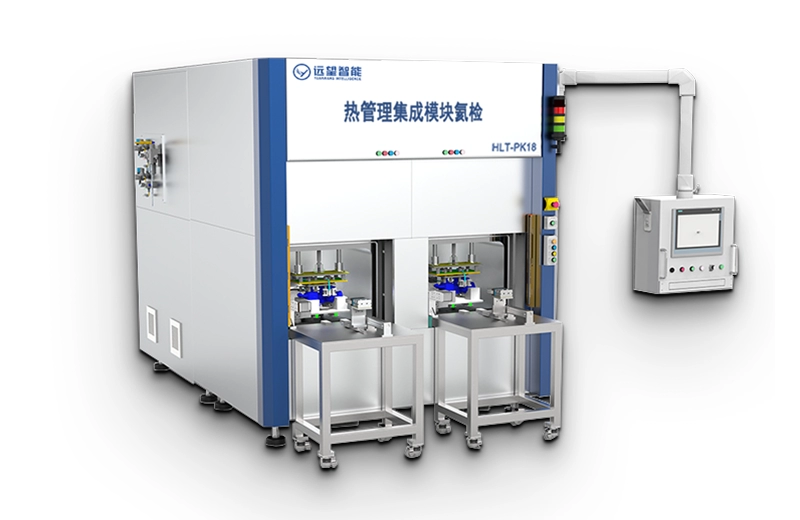
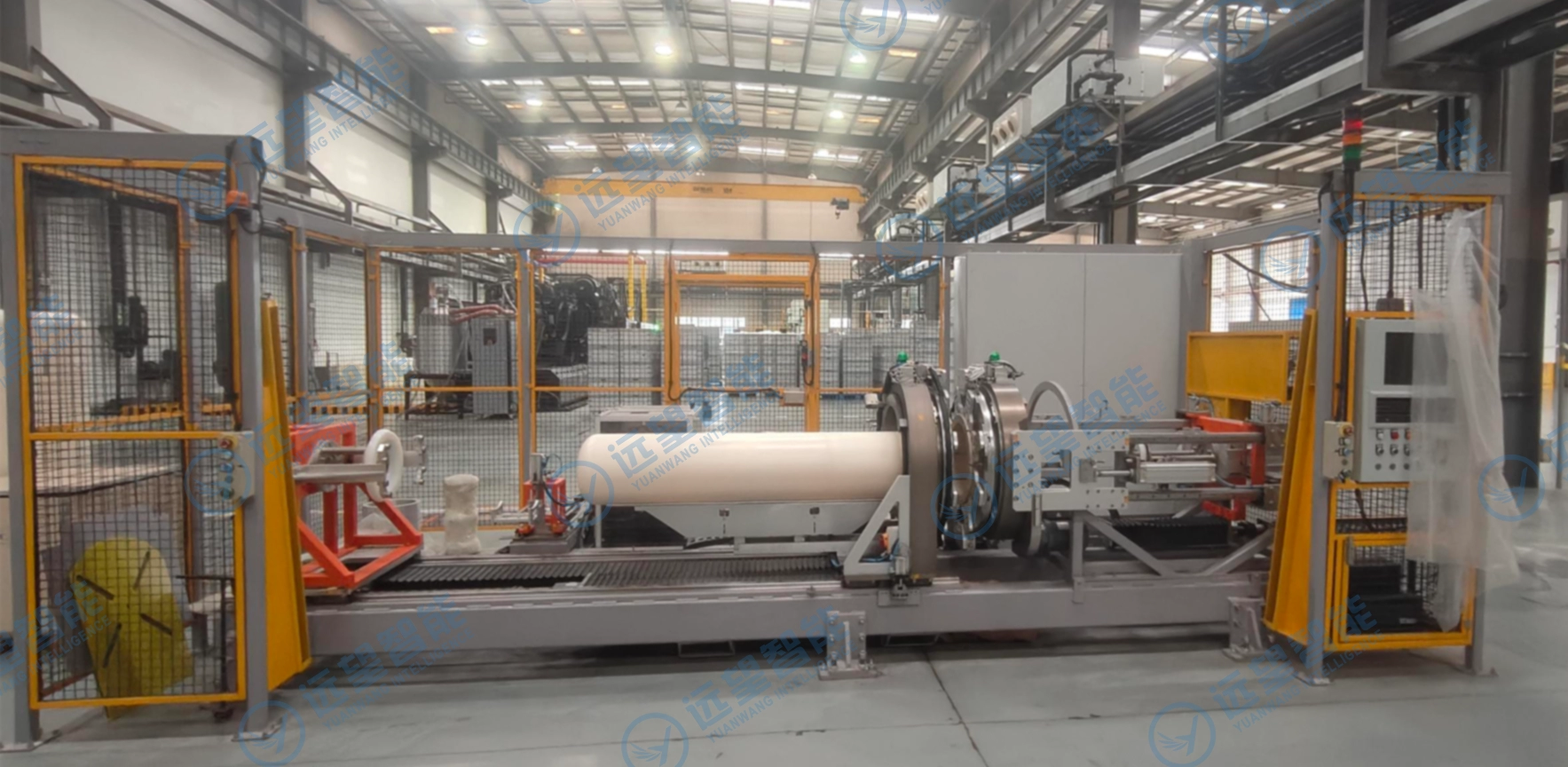
This equipment is specifically designed for Type IV hydrogen cylinder plastic liner manufacturing. It integrates an infrared rotational welding system, a servo-driven automatic clamping and feeding system, automatic weld flash trimming, an automatic liner straightening system, and the capability to adapt to different liner lengths. The entire machine can be embedded into a hydrogen cylinder production line, realizing full automation from liner half‑shell welding to flash removal.
Process Flow Diagram:

III. Detailed Core Process Features
3.1 Infrared Rotational Welding System: Wide, Uniform, Non‑Contact Heat Source
· Working principle: Medium‑wave and long‑wave infrared radiation is used for heating. Multiple infrared emitters are arranged in a ring configuration to heat the butt ends of the liner non‑contactly to a molten state (typical temperature 200–250°C). A servo press then joins the two parts, allowing polymer chain diffusion and entanglement for bonding.
· Technical advantages:
Heating uniformity: Infrared radiation covers the entire circumferential end face, avoiding local overheating or underheating; weld strength variation <5%.
Non‑contact: No sticking of molten plastic to the heating tool, suitable for high‑cleanliness liners.
Short cycle time: Typical welding time for a 60‑inch liner is about 40–60 seconds.
· Rotational capability: The welding head or workpiece can rotate axially, adapting to different liner lengths and non‑circular cross‑sections.
3.2 Servo‑Driven Automatic Clamping and Feeding System
· Function: Composed of multiple servo‑driven grippers and linear modules, it performs automatic pickup, centering clamping, transfer to the welding station, and post‑weld transfer to the trimming station.
· Precision control: Closed‑loop control with servo motors; clamping force programmable (e.g., 200–2000 N) to avoid deformation or damage of plastic parts.
· Line integration: Seamless connection with upstream/downstream conveyors and robotic loading/unloading systems, supporting high‑speed production (20–40 cylinders per hour).
3.3 Automatic Weld Flash Trimming
· Necessity: During infrared welding, molten plastic extrudes from the weld seam, forming internal and external flash. Internal flash, if not removed, can cut carbon fibers during winding; external flash affects the outer diameter accuracy and winding layer adhesion.
· Implementation: Dual‑spindle high‑speed milling units (with custom‑shaped tools) perform contour milling along the weld seam from both the inner and outer sides of the liner. Cutting parameters (spindle speed 8,000–15,000 rpm, feed rate) are controlled by CNC.
· Quality control: An integrated vacuum chip removal system prevents debris residue. An optional vision inspection module verifies flash removal effectiveness.
3.4 Automatic Liner Straightening System
· Function: Before and after welding, radial runout and coaxiality are measured and corrected. Multiple laser displacement sensors measure the circumferential profile of the liner. Minor corrections are made via servo‑driven pressure rollers or pneumatic pushers to ensure butt‑end gap ≤0.1 mm and misalignment ≤0.3 mm.
· Value: Eliminates welding defects (offset, lack of fusion) caused by plastic part warpage or incoming material deviations.
3.5 Adaptability to Different Liner Lengths
· Requirement: Commercial Type IV hydrogen cylinders range from 300 mm (passenger car) to over 2000 mm (heavy‑duty truck, bus). The equipment must enable rapid changeover.
· Solutions:
Adjustable fixture base: Left and right clamping units move along linear guides, with servo motor + ball screw automatic positioning to the set length.
Modular infrared heater array: The number and spacing of heaters can be reconfigured, or segment‑wise independent control can be applied to match different liner lengths.
Software recipe management: Operator scans barcode; PLC automatically recalls corresponding length, welding parameters, and milling path program. Changeover time <5 minutes.
IV. Production Line Integration and Smart Manufacturing
This equipment serves as a core unit in a complete Type IV hydrogen cylinder manufacturing line and is typically integrated with the following upstream/downstream equipment:
Industrial IoT capability: The equipment can integrate with MES systems, real‑time reporting of welding temperature curves, pressure curves, milling torque, length correction data, etc., enabling traceability for each cylinder (one‑cylinder‑one‑file). This forms the foundation for digitalized control of automated hydrogen cylinder production lines.
V. Summary and Industry Outlook
As hydrogen heavy‑duty trucks, logistics vehicles, and other demonstration projects move toward commercial deployment, Type IV hydrogen cylinders are entering a phase of large‑scale automated manufacturing. Infrared rotational welding, with its advantages of non‑contact heating, uniform melting, and low flash, has become the preferred process for liner joining. Meanwhile, the integrated servo clamping/feeding, automatic flash trimming, and liner straightening functions systematically address the industry pain point of weld consistency in large‑sized plastic components.
The equipment introduced by Yuanwang Intelligence is not just a single‑process breakthrough but a key link in hydrogen cylinder production line integration – the quality of welding and trimming directly determines the burst pressure and fatigue life of the final cylinder. The length‑adaptable solution covers cylinder specifications for passenger cars, light trucks, and heavy‑trucks, supporting the hydrogen industry’s vision of “standardized, high‑efficiency, traceable” manufacturing.