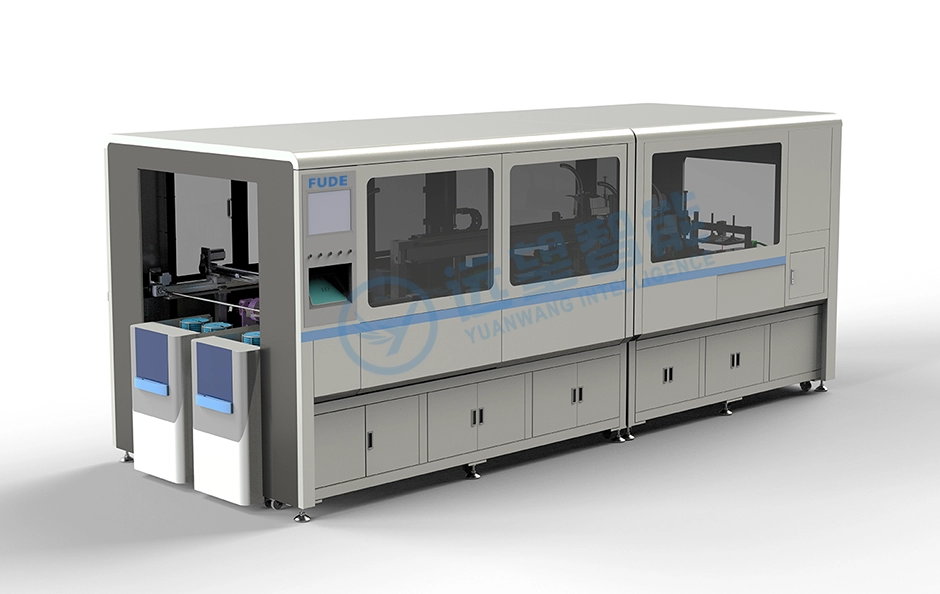
Against the backdrop of rapid growth in semiconductors, automotive electronics, consumer electronics, and artificial intelligence, the chip packaging process is facing unprecedented challenges: high throughput, zero defects, and full traceability. Traditional manual chip packaging is not only inefficient but also struggles to meet stringent requirements for moisture protection, electrostatic discharge (ESD) prevention, and physical damage avoidance. Shenzhen Yuanwang Industrial Automation Equipment Co., Ltd. (Yuanwang Intelligence) has developed an automated production line that provides a turnkey solution for chip packaging, integrating multiple tray and reel compatibility, cart‑fed batch loading, online label printing and applying, vision inspection, automatic desiccant and humidity indicator card dispensing, automatic bagging and vacuum sealing, automatic weighing, automatic carton packing, and MES system connectivity.
I. Industry Background: Chip Packaging – From “Auxiliary Process” to “Quality Defense Line”
After chip encapsulation, the chip packaging stage directly affects product reliability and safety during transport, storage, and surface‑mount assembly. Traditional chip packaging, which relies heavily on manual operations, has the following pain points:
· Contamination and damage risk: Manual handling can introduce ESD, perspiration residues, or mechanical scratches.
· Difficult moisture control: Moisture‑sensitive devices require packaging under strict humidity control; manual placement of desiccants and humidity indicator cards is prone to omissions or misplacement.
· Inefficient traceability: Label printing, applying, and data uploading depend on manual verification, leading to high error rates and inability to communicate with MES in real time.
· Throughput bottleneck: The chip packaging line often becomes the bottleneck in back‑end production, especially for high‑mix, small‑batch scenarios.
As high‑end devices such as automotive electronics and AI computing chips demand higher reliability, fully automated, highly integrated, and traceable chip packaging lines are becoming the standard for semiconductor OSATs, IDMs, and test houses.
II. Process Flow and Core Process Features
Yuanwang Intelligence’s automated chip packaging line adopts a modular design. Each station can operate independently or be connected via a conveyor system into a full line. The typical process flow is shown below:

The following sections detail each core process feature.
2.1 Compatibility with Multiple Tray and Reel Types
· Requirement: Test houses receive materials in various formats: JEDEC trays (matrix), waffle packs (individual cavities), and tape‑and‑reel reels (7″, 13″, 15″, etc.). The chip packaging equipment must support changeover within one hour.
· Implementation:
Trays: Adjustable frame positioning + vacuum suction to prevent shifting; supports sizes from 150×150 mm to 350×350 mm.
Reels: Interchangeable unwind shafts and tension control modules; outer diameter compatibility from 100 to 400 mm.
Recipe management: Product model selection via HMI or host computer; servo‑driven automatic adjustment of width and suction cup layout.
2.2 Cart‑Fed Batch Loading
· Function: Designed to interface with AGV docking stations or manual push carts. The operator pushes a cart loaded with trays/reels into the loading station; after locking, a robotic arm or transfer mechanism feeds each tray or reel sequentially.
· Advantages: Reduces manual handling and labor intensity; enables batch‑in/batch‑out operation, creating a buffer with upstream tape‑and‑reel machines or test handlers; cart design complies with SEMI standards and can accommodate existing customer logistics containers.
2.3 Online Label Printing and Applying
· Need: Every chip packaging unit (reel, tray, carton) must carry a unique identification code (PN, lot code, MSL level, production date, etc.) for supply chain traceability and smart warehouse integration.
· Implementation: Integrated high‑speed industrial printer (thermal transfer or direct thermal) that communicates with MES to obtain dynamic data. The label applicator uses a vacuum pick‑and‑place head with a pneumatic cylinder; placement accuracy ±1 mm, applicable to tape cover tape or tray sidewalls.
2.4 Vision Inspection System
· Inspection content: Chip orientation (via edge profile or laser marking), lead coplanarity and surface defects (high‑resolution camera + deep learning algorithms), barcode/Data Matrix reading and verification to ensure consistency with MES data.
· Value: Defective chips are rejected before chip packaging, preventing them from reaching customers; also provides traceable images for packaging quality records.
2.5 Automatic Desiccant and Humidity Indicator Card (HIC) Dispensing
· Process standard: Moisture‑sensitive devices (MSL rated) require internal package humidity <10% RH. Desiccant and HIC are placed according to J‑STD‑033.
· Automation implementation:
Desiccant: Roll or pouch material automatically cut and dispensed; quantity programmable (1–5 bags).
HIC: Multi‑magazine rotary feeder; vacuum pickup and placement on the tape or in tray corner.
Verification: Optional vision check after placement to confirm no omission.
2.6 Automatic Bagging and Vacuum Sealing System
· Process: Automatic bag picking → bag opening → insertion of tape reel or tray → bag mouth placement on sealing bar → vacuum to set value (e.g., 0.05–0.1 bar) → heat sealing → (optional) corner cutting → discharge.
· Key controls: Closed‑loop control of vacuum rate and sealing temperature to prevent incomplete seals or bag burn. Supports nitrogen purging for oxidation‑sensitive devices.
2.7 Automatic Weighing
· Purpose: Verifies that the package contains the correct quantity (e.g., no missing parts on a reel) and generates inbound weight data. Uses an industrial shock‑proof scale with ±0.5 g accuracy; compares against upper/lower limits; automatic rejection of outliers.
2.8 Automatic Carton Packing
· Scenario: When multiple reels or trays need to be assembled into an outer shipping carton, the equipment automatically erects the carton, folds and tapes the bottom flaps, places the inner packages inside (optional robotic placement), folds and tapes the top flaps, and applies the outer carton label.
· Carton size: Supports standard e‑commerce cartons or custom totes; quick changeover via servo‑adjusted flap folding mechanisms.
2.9 MES System Integration
· Data integration: Equipment communicates with the factory MES via SECS/GEM or OPC UA protocols, uploading in real time information such as batch feed counts, chip ID codes, vision inspection results and defect image indices, label content, desiccant/HIC quantities, vacuum level, sealing temperature, weight values, and packaging completion time and operator ID.
· Value: Enables end‑to‑end traceability, meeting automotive IATF 16949 and semiconductor quality management requirements. In case of a quality issue, the specific packaging batch and parameters can be quickly identified.
III. Production Line Integration and Flexible Configuration
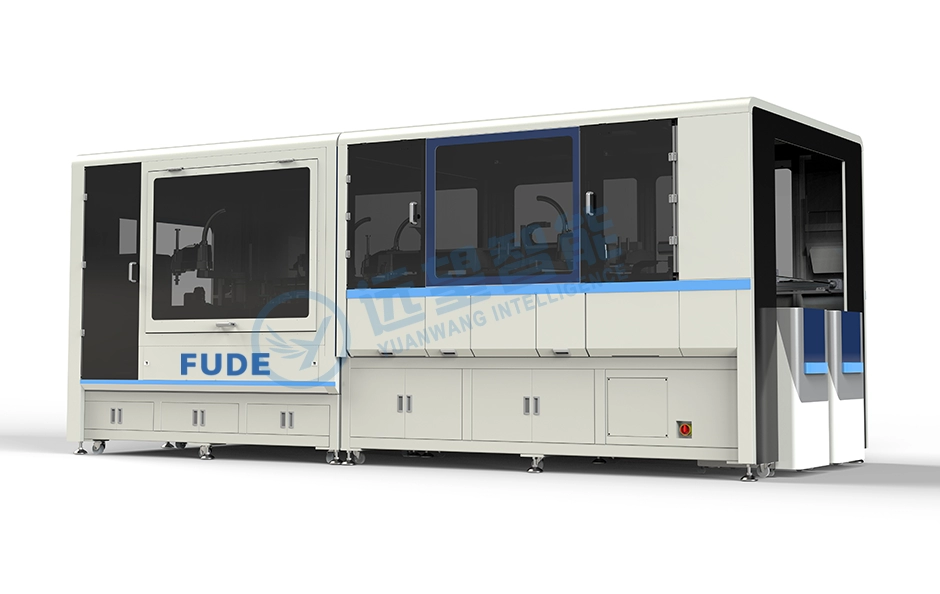
Yuanwang Intelligence’s chip packaging line is modular and can be flexibly configured according to production capacity and floor layout:
The line can directly interface with upstream chip test handlers and tape‑and‑reel machines, forming a complete back‑end automation loop from testing to chip packaging.
IV. Conclusion
Chip packaging has evolved from simple “pack and ship” to a critical quality control node in semiconductor manufacturing. Yuanwang Intelligence’s automated chip packaging line, featuring multi‑tray/reel compatibility, cart‑fed batch loading, online label printing and applying, full vision inspection, automatic desiccant/HIC dispensing, vacuum sealing, automatic weighing, automatic carton packing, and deep MES integration, systematically addresses the efficiency, reliability, and traceability challenges of chip packaging. This line is suitable for semiconductor OSATs, automotive electronics module manufacturers, AI accelerator board producers, and similar applications, helping customers achieve “zero defect, high efficiency, full traceability” in the chip packaging stage.