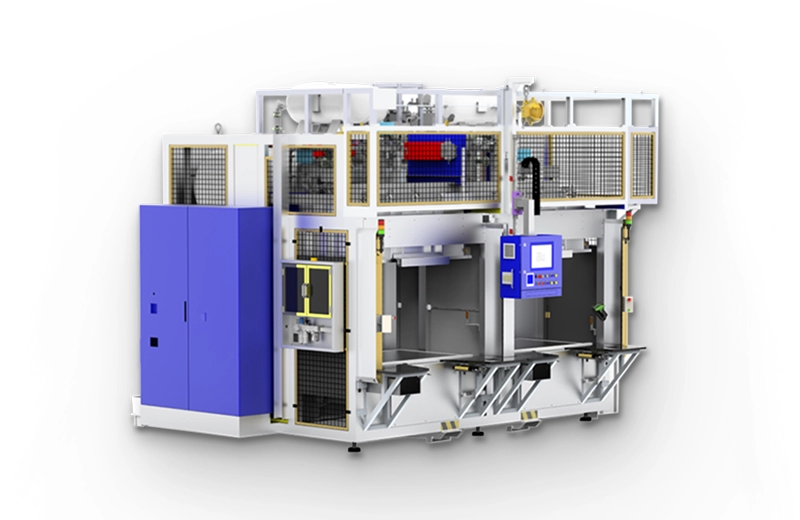
To address the common industry challenges of high tubing count, tight precision requirements, and stringent assembly standards in AI liquid cooling servers and new energy vehicle cleaning systems, Shenzhen Yuanwang Industrial Automation Equipment Co., Ltd. (referred to as "Yuanwang Intelligence") has launched a dedicated integrated machine that combines automatic cutting, ring-label application, damage-free transfer, vision-guided force-controlled insertion, and pull-out force online inspection. Actual production data shows that the machine reduces on-shift staffing from 5 to 1, increases overall efficiency by a factor of 8, and raises first-pass assembly yield from approximately 85% to over 99.8%, effectively resolving long-standing process pain points such as inaccurate insertion depth, tube-end damage, and insufficient pull-out resistance.
I. Industry Background: Precision Tubing Assembly – A Critical Bottleneck for Capacity and Quality
With the rapid expansion of AI computing infrastructure, the penetration rate of liquid cooling servers continues to rise. The thermal design power (TDP) of a single rack has exceeded the 100 kW level, significantly increasing the complexity of liquid cooling tubing systems. Simultaneously, demand for new energy vehicle cleaning systems is surging, driving a sharp increase in orders for tubing-type components. Both application scenarios share common characteristics: a wide variety of tubing types, tight tolerances on length and interface dimensions, and a high risk of irreversible damage during assembly. End customers impose far stricter qualification standards on sealing performance, pull-out resistance, and long-term reliability than typical industrial products.
In traditional production modes, processes such as tube cutting, ring-label application, transfer and alignment, insertion into connectors, and pull-out force testing are heavily dependent on manual labor. Site statistics indicate that an assembly line staffed with five operators, each taking turns or handling different steps in sequence, still achieves a first-pass yield persistently below 90%. Customer complaints primarily focus on incomplete insertion, tube-end scratches, misaligned labels, and substandard pull-out resistance.
II. System Overview: Fully Automated Process Integration
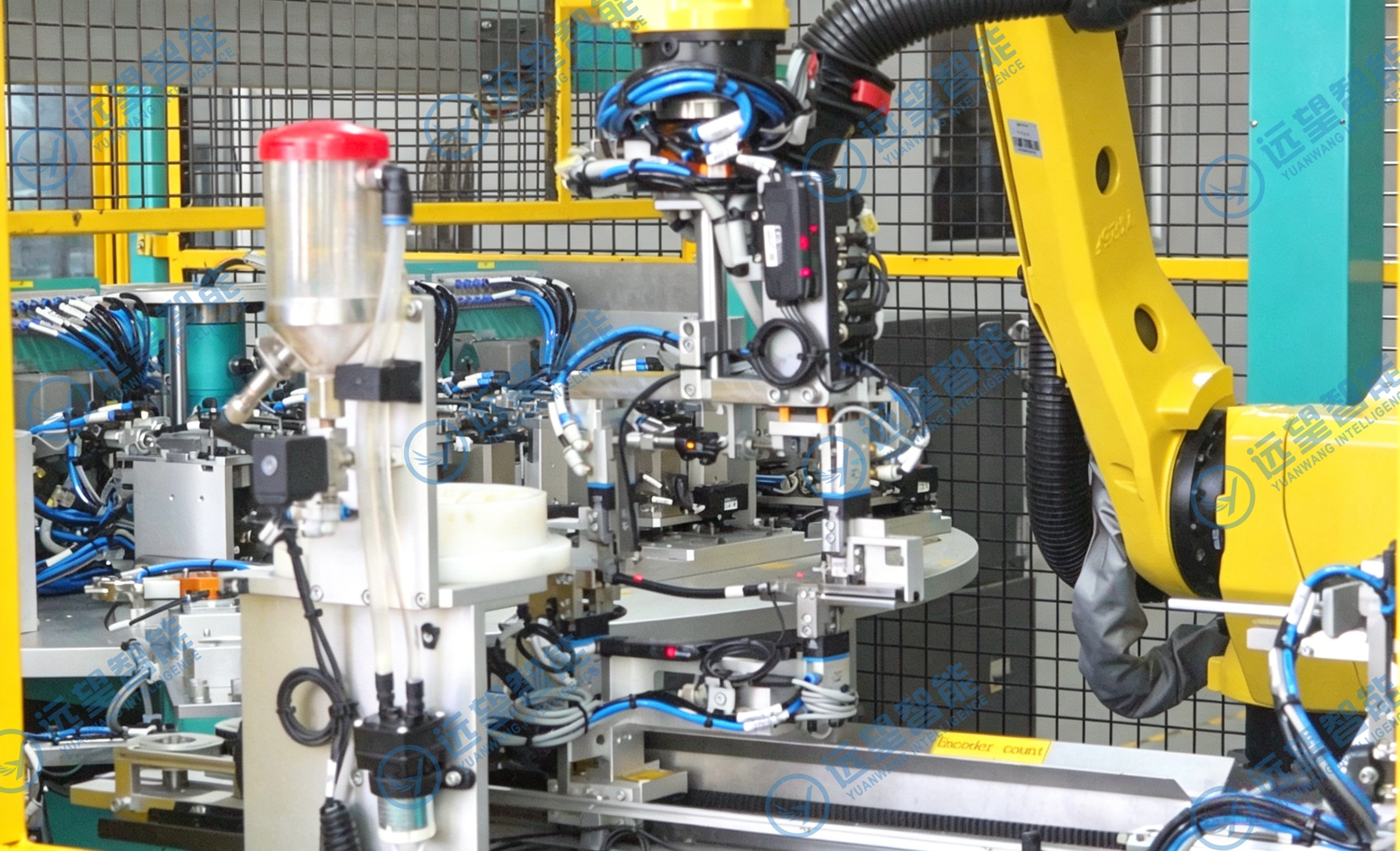
Yuanwang Intelligence’s dedicated integrated machine consolidates previously discrete, manual operations into a continuous automated workflow. The system comprises the following functional modules:
· Automatic Cutting Module: Performs fixed-length cutting of incoming tubes, accommodating different diameters and materials.
· Automatic Ring-Label Applicator: Completes automatic label pick-up, positioning, and application.
· Automatic Transfer Module: Moves tubes between stations while avoiding contact with or impact to the tube ends.
· Vision-Guided Force-Controlled Insertion Module: Uses vision to locate the tube end and connector entry, then performs precision insertion with a force-controlled servo axis.
· Automatic Pull-Out Force Testing and Reject Module: Applies a standardized pull-out test after insertion; rejects non-conforming parts directly.
All modules are synchronized via a control system, enabling end-to-end automation from loose tubes to finished, inspected assemblies.
III. Key Technical Specifications and Implementation
3.1 Cutting Accuracy: ±0.3 mm
The machine employs a precision length-setting mechanism and a high-response cutter, controlling cutting length error within ±0.3 mm. In contrast to manual cutting that relies on visual estimation and hand tools, this accuracy level meets the length-consistency requirements of liquid cooling tubing interfaces.
3.2 Automatic Ring-Label Application
Replacing manual one-by-one label attachment, the machine uses rotary positioning and pressure control to achieve consistent alignment of the label’s start and end positions, eliminating the skewed, wrinkled, or misplaced labels common in manual operations.
3.3 Damage-Free Transfer
During transfer between cutting, labeling, and insertion stations, the machine employs flexible gripping and path planning strategies, keeping critical gripping points away from tube-end sealing surfaces and internal walls. Production records show that incidents of tube-end impact or scratch-related scrap have been eliminated.
3.4 Vision-Guided Force-Controlled Insertion
Insertion Depth Tolerance: ±0.5 mm | No Internal Wall Damage
This module is the technical core of the machine. The vision system identifies the tube-end position and the connector entry coordinates, guiding a robot or linear module for coarse alignment. The force-control system continuously monitors axial resistance and angular deviation during insertion. If abnormal resistance or torque limit exceedance is detected, the system automatically adjusts the insertion attitude or stops and alarms, preventing forced insertion that could damage the internal wall or sealing structure. The final insertion depth error is maintained within ±0.5 mm.
3.5 Post-Insertion Pull-Out Force Automatic Inspection
Upon completion of each tube insertion, the machine instantly executes a standardized pull‑out test, applying an axial pulling force at a defined value and measuring displacement or hold time. Products with pull‑out force below the specification limit are automatically diverted to a reject lane and do not proceed to the next process. Test data can be uploaded to the MES (Manufacturing Execution System), ensuring full traceability per batch and per tube.
IV. Production Validation: Customer Line Data
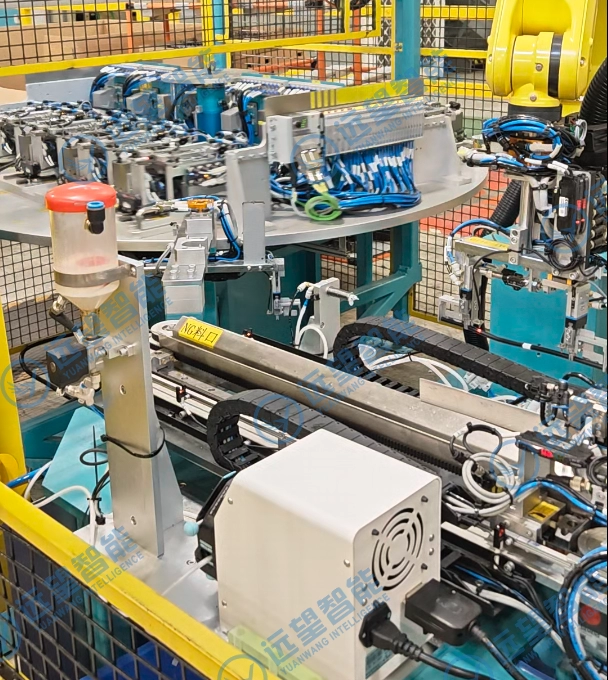
The equipment has been delivered and commissioned on the production line of a leading manufacturer of liquid cooling components and new energy thermal management systems. Comparative data are as follows:
According to customer feedback, the three long-standing process difficulties – inconsistent insertion depth, insufficient pull-out resistance, and tube-end damage – have been resolved completely after deployment of this equipment. After the first machine completed commissioning and achieved stable operation, the customer placed an immediate follow‑on order for three additional units.
V. Summary
Yuanwang Intelligence’s dedicated integrated machine for AI liquid cooling server and new energy vehicle cleaning system tubing – combining precision cutting, automatic ring‑labeling, damage‑free transfer, vision‑guided force‑controlled insertion, and online pull‑out force testing – transforms tube assembly from a manual, experience‑dependent operation into a quantifiable, automated process. Real‑world production data confirm substantial improvements in labor efficiency, yield, and process stability. For supply chain companies facing capacity ramp‑up challenges and stringent customer audits in the liquid cooling and new energy vehicle tubing domains, this equipment offers a proven, viable automation solution.